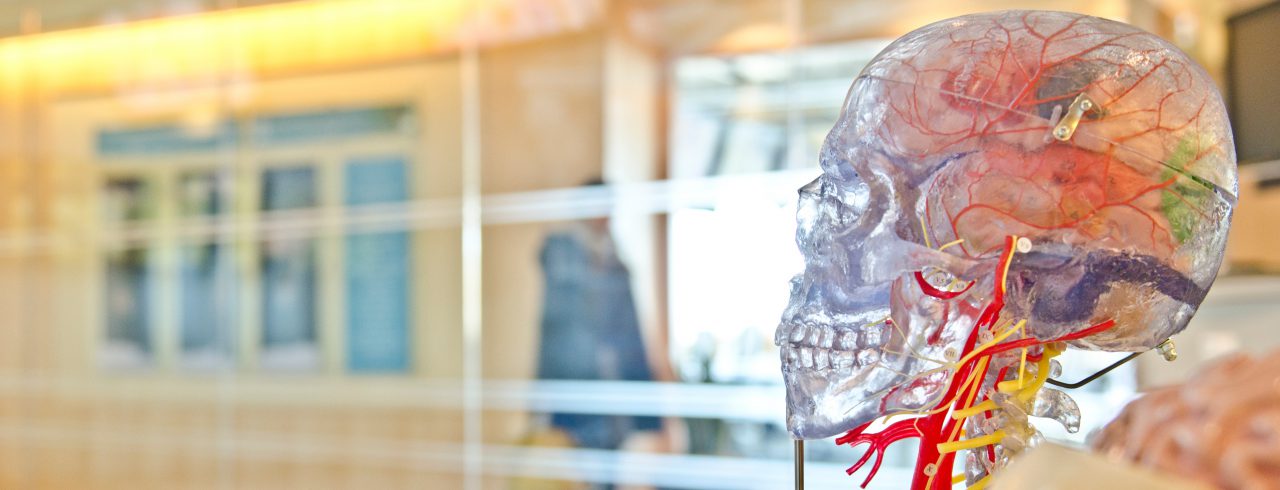
Neuroanatomy lab ended this morning as it always does, with a 5 question, all-or-nothing quiz. There was a palpable sigh in the room as the pin went into the brain. Most students had no idea what structure the pin was in. They were confused. And when the answer was later revealed, they were frustrated.
Since the brain is a 3-dimensional object, the same structures can be seen from different views. Most students will study and know a structure really well from one view. But when that same structure is presented from another view, like what happened on the quiz, it’s easy to get lost.
One student approached me after lab and asked an important question. How is he supposed to identify an anatomical structure when looking at it from an unfamiliar viewpoint? My response to this student on how to learn anatomy (from all views) reminded me of how a pilot navigates when flying.
***
My father earned his private pilot’s license a few years ago and since then, he’s taken me up a few times for a flight in a Cessna 185. Every time, I’m always amazed the way my little piece of the world looks at 4000 feet. Like looking down on an elaborate model railroad town you can admire the details, noticing individual houses, hydro poles, and streets, while at the same time getting the perspective of seeing everything all at once.
Although GPS devices are commonly used for directions when flying a plane, pilots initially learn to navigate without this technology. Not only is it helpful, but it’s necessary. Pilots have to learn how to read a map and navigate from the air because unlike driving a car if the electronics fail there’s no pulling over to ask for directions. So in the passenger seat of the plane, I watched my father fly without a GPS and I learned the basic principles of navigation.
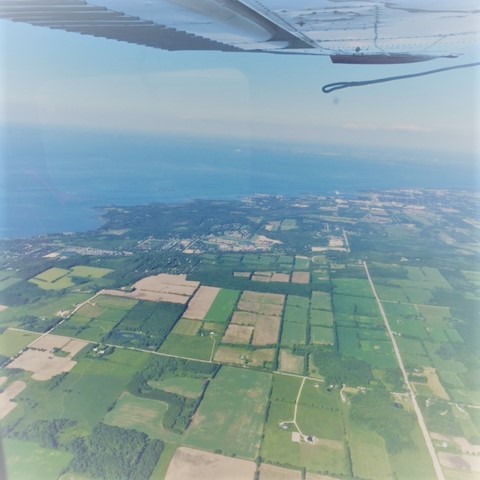
Once in the air, he would search for a point of certainty, a landmark that he could easily identify whose location he knew without a doubt. Then he used the cardinal directions (North, East, South, West) to recall relationships between the point of certainty and other landmarks. Sometimes he might take a bit of time to get his bearings but by staying calm and being observant, he was always able to find his way to where he wanted to go. What I didn’t see, was all the preparation that it took in order for this process to be effective.
Before ever getting to the airport, he intensely studied the map, especially when planning to fly into unfamiliar territory. He would follow the route of his flight plan on the map and find easily recognizable landmarks, his points of certainty. Then he formed a relationship between a point of certainty and another landmark that would help him find his way. For example, “The ski hill is south of the lake and west of the highway”.
***
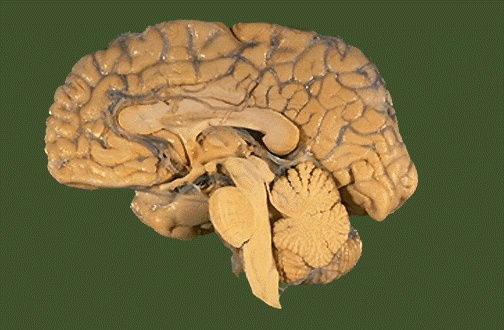
I explained something like this to the student after the lab quiz this morning and then we practiced. First, we looked at the view of the brain that he knew well. The fourth ventricle became his point of certainty. Then we made relationships between it and different structures. “The roof of the 4th ventricle is the superior medullary velum and the superior cerebellar peduncles are lateral to the superior medullary velum.”
We then switched to another specimen and looked at the brain from another viewpoint; the one where earlier, he had felt lost. He found his point of certainty, the 4th ventricle. From there, he found its roof, the superior medullary velum. Then he went lateral to find the superior cerebellar peduncle. All of a sudden, the quiz question didn’t seem so difficult to understand.
It doesn’t matter what field you’re learning anatomy for, learning anatomy is all about learning the relationships between structures.
- Study the anatomy textbook beforehand and pick a few easy-to-find structures, your points of certainty.
- Use the anatomical directions (superior, inferior, medial, lateral, superficial, deep) to create relationships between a point of certainty and other structures you need to learn.
- When you’re lost or confused, start from a point of certainty and use the relationships to find the structure that you’re looking for.
Don’t expect to immediately become an expert in anatomy. But as you use this process to learn anatomy, your repertoire of points of certainty grows and finding anatomical structures will become quicker and more automatic.
Even from my observations of experienced anatomists, none of them seem to rely on a sort of internal ‘Anatomical Positioning System’. They always find what they’re looking for by using the relationships between anatomical structures. Because while anatomy can look different from person to person and from view to view, the relationships stay the same.
Expert anatomists know the relationships between anatomical structures extremely well.
I am, by no means, taking credit for this learning strategy. The concept of using relationships to learn anatomy is not new. But I do think that it is underappreciated.
I only realized this strategy after carefully observing my mentors as they were teaching anatomy. I learned anatomy years ago, without realizing that this is how I was doing it. And I’m sure that other students are also learning anatomy this way without even realizing it.
By bringing this strategy to our awareness, we can use it properly and frequently, especially when we’re learning anatomy and we feel lost or confused. And if it’s not supposed to be used like a map, why else would the anatomy textbook be called an Anatomy Atlas?
Keep learning,
Dr. K
Comment below:
Have you used this strategy for learning anatomy?
If so, how did it work for you?
 Mastering Clinical Anatomy
Pingback: How to Take an Anatomy Bell Ringer Exam – Mastering Clinical Anatomy